Old School Text Classification
Just about any LLM can do text classification reasonably well. But sometimes there is a need for more. Some problems are narrow, stable, and repeated millions of times. In that setting accuracy, throughput and cost must be measured.
This is an experiment with finetuning on a narrow classification domain - I use paper abstracts taken from arXiv as input and predict the subject areas.
EDA
The source is the Cornell arXiv snapshot - over 3 million papers. I mapped arXiv's detailed categories into five broad labels. Other categories (mostly math) are excluded. That leaves a bit over 2.6 million usable records:
biology | chemistry | computer science | physics | social sciences
This is a multi-label problem. A paper can be primarily about physics and cross-listed in chemistry. Most papers have one label, but ~143k have two or more. The data is also imbalanced:
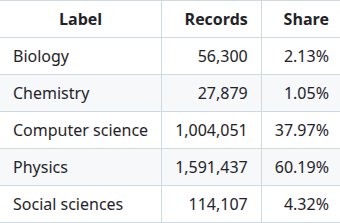
The percentages exceed 100% because of the multiple labels. I opted for macro F1 as the primary metric. Micro F1 is also relevant so I report it, but Macro F1 is harder given what we're working with.
Chemistry presents another problem. Almost half of the samples are secondary labels, often on physics papers. The label reflects how an author chose to submit a paper, not necessarily what can be inferred from the abstract.
Abstracts are relatively short. The median is 144 words and the 95th percentile is 255 words. A 512-token context window seems reasonable.
Preprocessing
I first ran quick training runs with different preprocessing options on a random 10k sample. Conventional NLP techniques - lowercase, lemmatize, strip stopwords. This regressed the model's performance compared to doing no preprocessing. Upon inspection, I realized that BERT might seem ancient but those transformations are unnecessary.
On abstract length:
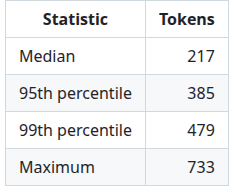
0.5% exceeded the token limit. Upon inspection, I found two things:
- TeX markup
- Long mathematical expressions
I used a TeX parser to strip commonly observed markup and substituted the long formulas with a dedicated <FORMULA> token.
After normalization:
- median length fell from 217 to 207 tokens
- the 95th percentile from 385 to 357
- the share beyond 512 tokens from 0.49% to 0.03%
- the normalized sample produced no <UNK> tokens
This was also validated with a small training run - now doing better than the unprocessed baseline. The main takeaway here is that data inspection revealed domain-specific normalization steps.
Training setup
A head with 5 sigmoid outputs (one per category) is installed on top of the pretrained model. Here's the training split:
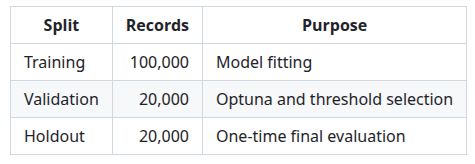
Validation and holdout retained the natural distribution. Training was sampled to include at least 8,000 positives for each rare label where possible - as the goal was to train for macro F1.
Primary categories received a target of 1.0; secondary received 0.5. The model produces five independent sigmoid probabilities. A secondary category is useful but weaker evidence.
Four models were fine-tuned:
- bert-base-uncased, 110m parameters, 2018
- ModernBERT-base, 149m parameters, 2024
- EmbeddingGemma-300m, 308m parameters, 2025
- Qwen3-Embedding-0.6B, 600m parameters, 2025
The pipeline is as follows:
- Freeze the base model and train only the head
- Unfreeze the base model and train it end-to-end
- Run Optuna hyperparameter search - 16 trials on 5k records over LR, WD, and warmup ratio
- Retrain with the best hyperparameters on 100k records
- Evaluate on the holdout
Results
The process was repeated for all four models. Here are the results:
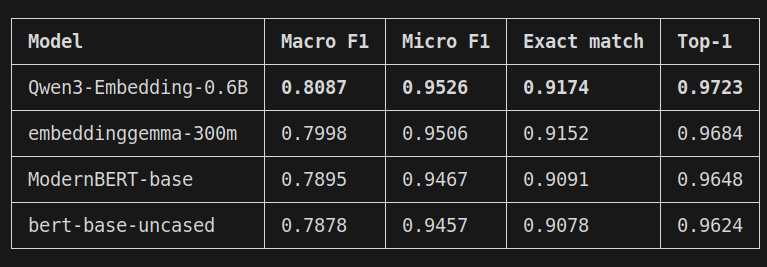
And here is the improvement over the frozen embeddings. This is noteworthy, as training on frozen embeddings is much faster:

And here's the throughput, as measured on my RTX 3090:

LLM Comparison
As a separate experiment, I evaluated LLM that was already running locally: Qwen3.8-27B (fp8). To simplify the task, I used a single-label prompt and reported top-1 accuracy.

This setup achieved 92.38% top-1 accuracy, down from 96.24% (finetuned BERT). Inference was quite slow too - ~1h30m. For comparison, the optuna search and finetuning took less than 1 hour total for BERT.
Prompt optimization could improve the key metrics. But the performance is unlikely to improve significantly on my hardware - it's just much slower.
Resources
The four finetunes are available here:
The code is available here. There are instructions on how to run the trained models in the README.
Conclusion
This experiment showed that sometimes finetuning makes sense. For a narrow, predictable workload, a fine-tuned model achieved:
- better top-1 accuracy
- faster inference
- lower resource usage
The complete experiment took roughly two days of work, including training.
BERT may be from another era, but for bounded problems it proved to be a good baseline.